Concepts
HarnessWeaver is a framework that produces harnesses. Each app team assembles its own harness from a small core plus swappable parts, and the platform team's org baseline applies to every app and can't be removed.
Who writes what
| Who | Writes | Examples |
|---|---|---|
| HarnessWeaver | The spec format, the core (lifecycle, budgets, hook bus, error taxonomy), standard modules, plugins for popular frameworks and model APIs, a sidecar for other languages, a CLI, templates and a test kit | harnessweaver, harnessweaver-openai, harnessd |
| The platform or security team | An org baseline profile (mandatory controls, locked values, bounds) and the list of approved plugins | org://acme-baseline@^1 |
| Each app team | A harness.yaml, its prompts, its tools and any app-specific plugins. It keeps whatever executor it already uses |
Raw SDK calls, Pydantic AI, the Vercel AI SDK, a custom loop |
The layers
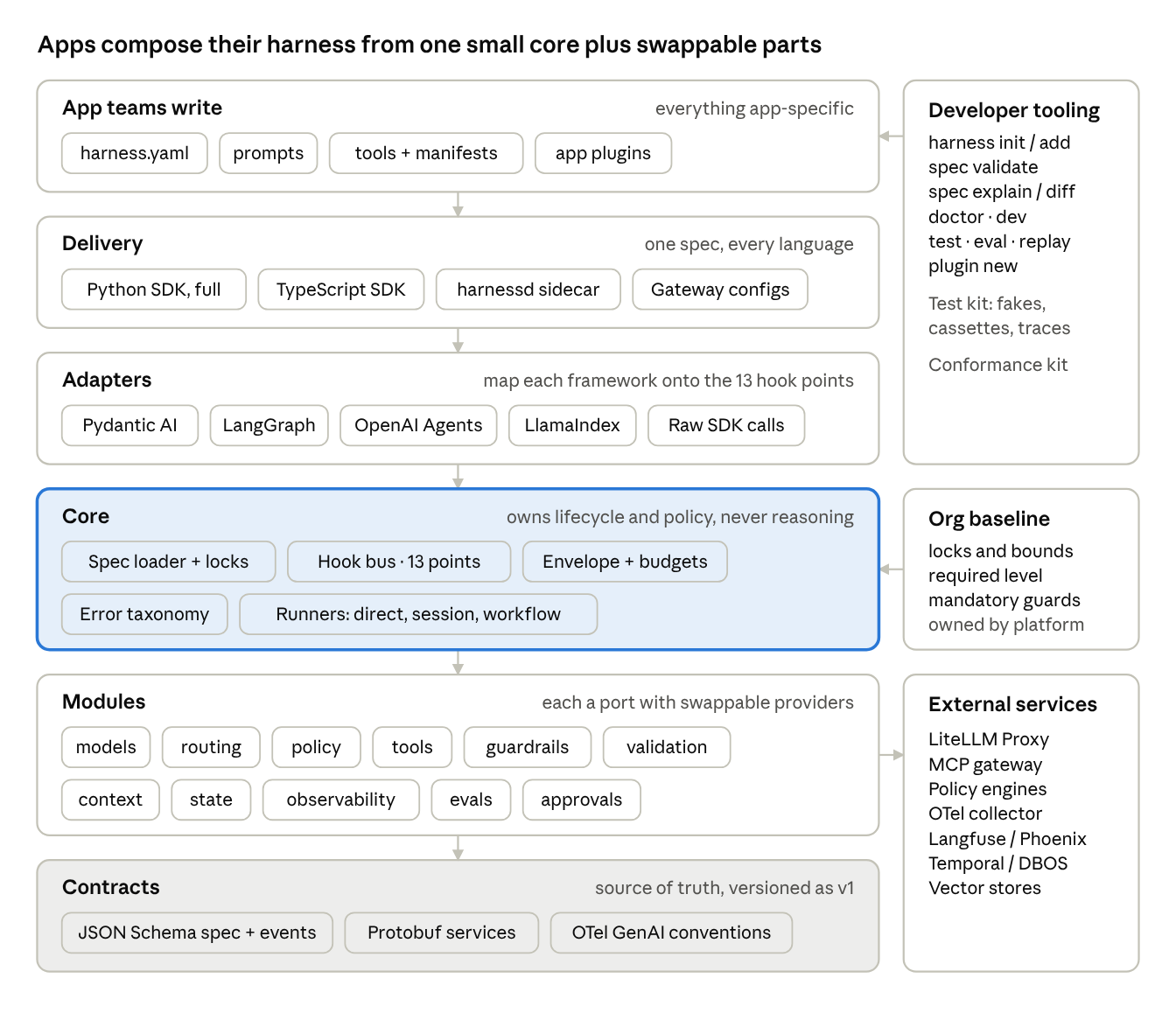
App teams touch only the top layer and their spec. Everything below it ships with HarnessWeaver or comes from the platform team. The core is small: it owns lifecycle and policy, and delegates all reasoning to whatever runner the app chose.
flowchart TB
    A["<b>App teams write</b><br/>harness.yaml, prompts, tools + manifests, app plugins"]
    D["<b>Delivery</b> - one spec, every language<br/>Python SDK (full), TypeScript SDK, harnessd sidecar, gateway configs"]
    AD["<b>Adapters</b> - map each framework onto the 13 hook points<br/>Pydantic AI, raw OpenAI / Anthropic SDKs, Vercel AI SDK"]
    C["<b>Core</b> - owns lifecycle and policy, never reasoning<br/>spec loader + locks, hook bus, envelope + budgets, error taxonomy, runners"]
    M["<b>Modules</b> - each a port with swappable providers<br/>models, routing, policy, tools, approvals, guardrails, validation, context, state, observability, evals"]
    K["<b>Contracts</b> - source of truth, versioned as v1<br/>JSON Schema spec + events, OpenAPI services, OTel GenAI conventions"]
    A --> D --> AD --> C --> M --> K
    BL["<b>Org baseline</b><br/>locks, bounds, required level, mandatory guards"] -. merged at load .-> C
    TL["<b>Developer tooling</b><br/>CLI, templates, test kit, conformance kit"] -.-> A
The design guide's original rendering of the same model:
Twelve concepts
Everything else is an implementation detail of a module.
| Concept | What it is | Defined by | In code |
|---|---|---|---|
| Harness | The runtime object an app builds from a spec. It runs tasks, opens sessions, and wraps or instruments existing clients and agents | HarnessWeaver, from the app's spec | hw.Harness, hw.load(...) |
| Spec | The declarative definition of one app's harness, usually harness.yaml |
The app team | hw.HarnessSpec |
| Profile | A reusable partial spec. Built-in profiles preset modules for a kind of app; the org baseline is a profile with locks and bounds | HarnessWeaver, the platform team, plugins | hw.ProfileSpec, extends: |
| Task | A named, versioned unit of work with input and output types, a runner, a prompt, a budget and task-level controls | The app team | tasks.<name> |
| Envelope | The immutable context carried through every call: run id, tenant, principal, task, budget, deadline, labels | HarnessWeaver, from the request | hw.Envelope |
| Hook point | One of 13 named moments in the lifecycle (model.before, tool.before, ...). Everything that governs a run attaches here |
HarnessWeaver (a fixed, versioned set) | hw.HookPoint |
| Middleware | A function attached to hook points. It can observe, modify, block, retry, escalate or suspend | Modules, plugins, apps | @hw.middleware |
| Port | A typed interface for one capability: Guardrail, PolicyEngine, ModelProvider, Decider, ... |
HarnessWeaver | harnessweaver.ports |
| Provider | A concrete implementation of a port, such as pii.regex for Guardrail |
HarnessWeaver, plugins, apps | @hw.provider |
| Module | A bundle that wires one capability end to end: its port, a default provider, the middleware it installs and its spec section | HarnessWeaver | guardrails:, tools:, ... |
| Runner | What executes a task: direct, session, workflow, pydantic_ai.agent, or your own. Runners don't implement controls; hook points do |
HarnessWeaver, plugins | @hw.runner |
| Plugin | A package or module that contributes providers, middleware, routing stages, runners, adapters, profiles or templates, through one contract, whatever its name | HarnessWeaver, third parties, apps | hw.Plugin |
How they connect: a spec selects modules. Each module configures a provider behind its port and installs middleware on hook points. The runner (or your own code, in a session) emits hook events as the work happens, and every event carries the envelope.
flowchart LR
    spec[harness.yaml<br/>+ org baseline] -->|selects| mod[Modules]
    mod -->|configure| prov[Providers<br/>behind ports]
    mod -->|install| mw[Middleware]
    mw -->|attach to| hooks[13 hook points]
    runner[Runner or adapter] -->|emits events on| hooks
    hooks -->|every event carries| env[Envelope]
    hooks -->|outcomes| bus{Hook bus<br/>bands, onion order,<br/>most severe wins}
Design goals
Every feature is tested against these goals, in this order. When two conflict, the earlier one wins.
- Safe by default, removable by nobody. Org baseline controls apply automatically and can't be switched off by app config.
- Non-invasive. HarnessWeaver wraps whatever the app already uses. Adopting it never requires rewriting an agent or switching frameworks.
- Incremental. Each adoption level is useful on its own. One line of code gets you level 0.
- Composable. Every capability is a module behind a port. Apps pick modules; modules pick providers.
- Declarative first, code when needed. Common setup is YAML. Anything YAML can't express is a plain Python or TypeScript function in a plugin.
- Small core. The Python core depends only on Pydantic, the OpenTelemetry API, PyYAML, anyio and loguru. Everything heavy is a plugin.
- Polyglot by contract. One spec format and one set of wire contracts serve Python, TypeScript and any language that speaks HTTP.
- Testable. Every module runs against fakes, and every plugin passes a shared conformance suite.
- Stable extension surface. Hook points, ports and the spec are versioned and change slowly. Internals can change freely.
- Observable. Every decision HarnessWeaver makes (a route chosen, a guard fired, a tool denied, a budget hit) is a traced event.
Non-goals. HarnessWeaver is not an agent framework, a prompt library, a vector database, a model host or a hosted platform. It doesn't pick an app's model, prompt, retrieval method or workflow.
Read next
- Lifecycle and hook points: the 13 hook points and a run end to end.
- The hook bus: how many middleware act on one event predictably.
- Outcomes and errors: what middleware can answer, and how runs end.
- Envelope, labels and budgets: the context every call carries.
- Integration styles: Wrap, Session and Run.
- Adoption levels: from L0 Observe to L4 Improve.
The full architecture, with every decision and its reason, is DESIGNS.md; the invariants it upholds are in RULES.md.